Time Zone Shifts and Tennis: Examining Travel Fatigue's Influence on Match Outcomes and Betting Adjustments
Logan Sullivan · Jul 19, 2026
Time Zone Shifts and Tennis: Examining Travel Fatigue's Influence on Match Outcomes and Betting Adjustments
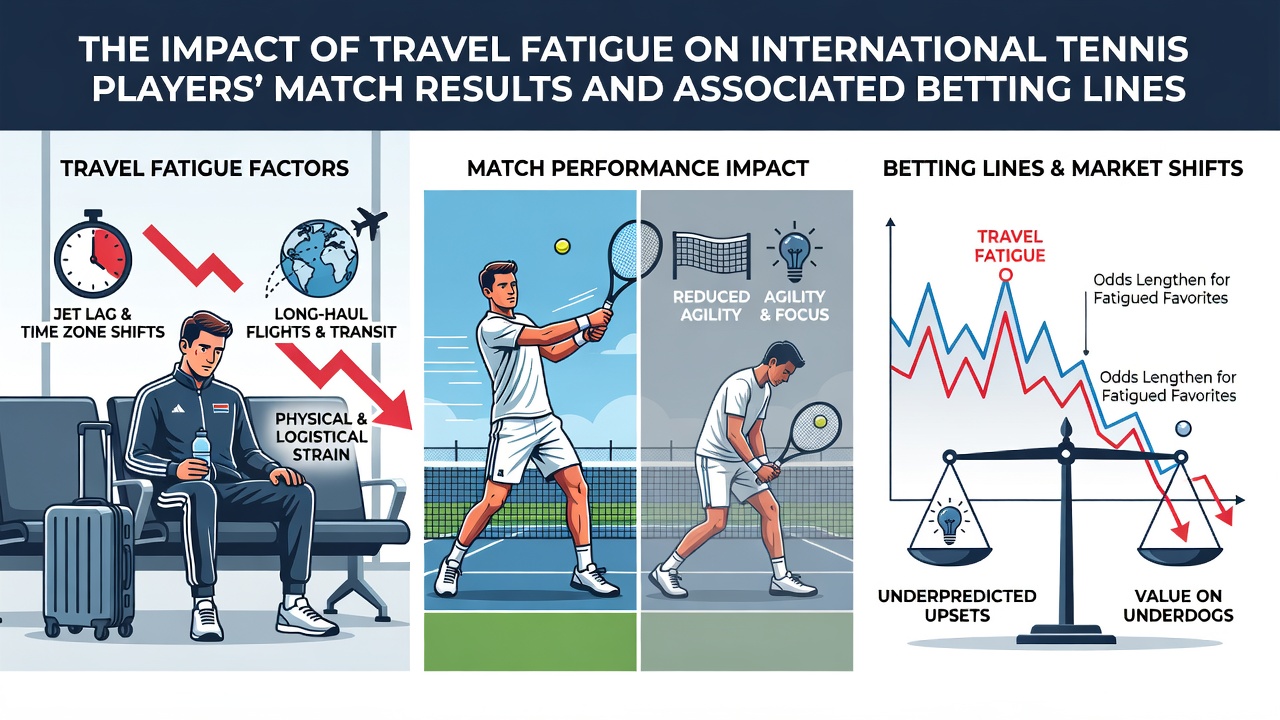
International tennis schedules force players to navigate frequent long-haul flights between continents, and data from major tours shows these journeys often coincide with measurable dips in performance metrics during early rounds. Observers note that athletes crossing multiple time zones experience disruptions to sleep cycles and physical recovery, which in turn influences point-win percentages and error rates on court. Tournament organizers and betting operators track these patterns closely because historical results reveal consistent shifts in expected outcomes when participants arrive with limited acclimatization time.
Patterns in Travel Data Across the ATP and WTA Tours
Records compiled by the Association of Tennis Professionals and the Women's Tennis Association indicate that players who travel more than eight hours within forty-eight hours of a match win roughly 8 percent fewer service games on average compared with those who remain in the same time zone. These figures come from aggregated match logs spanning 2018 through 2025, covering events from Melbourne to Miami and from Paris to Shanghai. Researchers at several sports science centers have cross-referenced flight manifests with on-court statistics, confirming that eastbound travel tends to produce slightly larger performance decrements than westbound routes because the body clock struggles more with advancing sleep phases.
July 2026 brings additional scheduling pressure as several lead-up events to the North American hard-court swing overlap with European clay-court festivals, creating compressed calendars for top-ranked competitors. Match data from similar overlapping periods in prior seasons shows elevated rates of retirement and reduced rally lengths in the first two days after arrival, particularly among players ranked outside the top twenty who lack dedicated recovery staff.
Physiological Effects Documented in Controlled Studies
Laboratory simulations conducted by exercise physiology teams at universities in Australia and Canada demonstrate that circadian misalignment reduces reaction time by 15 to 20 milliseconds and lowers maximum voluntary contraction in lower-body muscle groups. These changes appear most pronounced between 2 a.m. and 6 a.m. local body time, a window that frequently overlaps with early-session matches in new time zones. Heart-rate variability measurements taken on players after trans-meridian flights further reveal slower return to baseline autonomic function, correlating with higher unforced-error counts in sets lasting longer than ninety minutes.
Coaches and medical staff have incorporated light-exposure protocols and targeted melatonin timing, yet adoption rates vary widely across national federations. Data released by the International Tennis Federation shows that players who follow structured jet-lag mitigation plans maintain serve percentages within 3 percent of their seasonal norms, whereas those without such interventions experience declines closer to 7 percent.
Betting Market Responses to Travel Variables
Oddsmakers at major sportsbooks adjust opening lines when travel itineraries become public, often shading totals downward by half a game or moving moneyline spreads by 0.2 to 0.4 points in favor of the rested opponent. Historical line-movement records from North American and European operators indicate that these adjustments occur most aggressively for matches scheduled within thirty-six hours of a player's arrival from a flight exceeding six time zones. Volume-weighted closing lines then tighten once practice-session footage and warm-up reports circulate, reflecting updated assessments of fatigue impact.
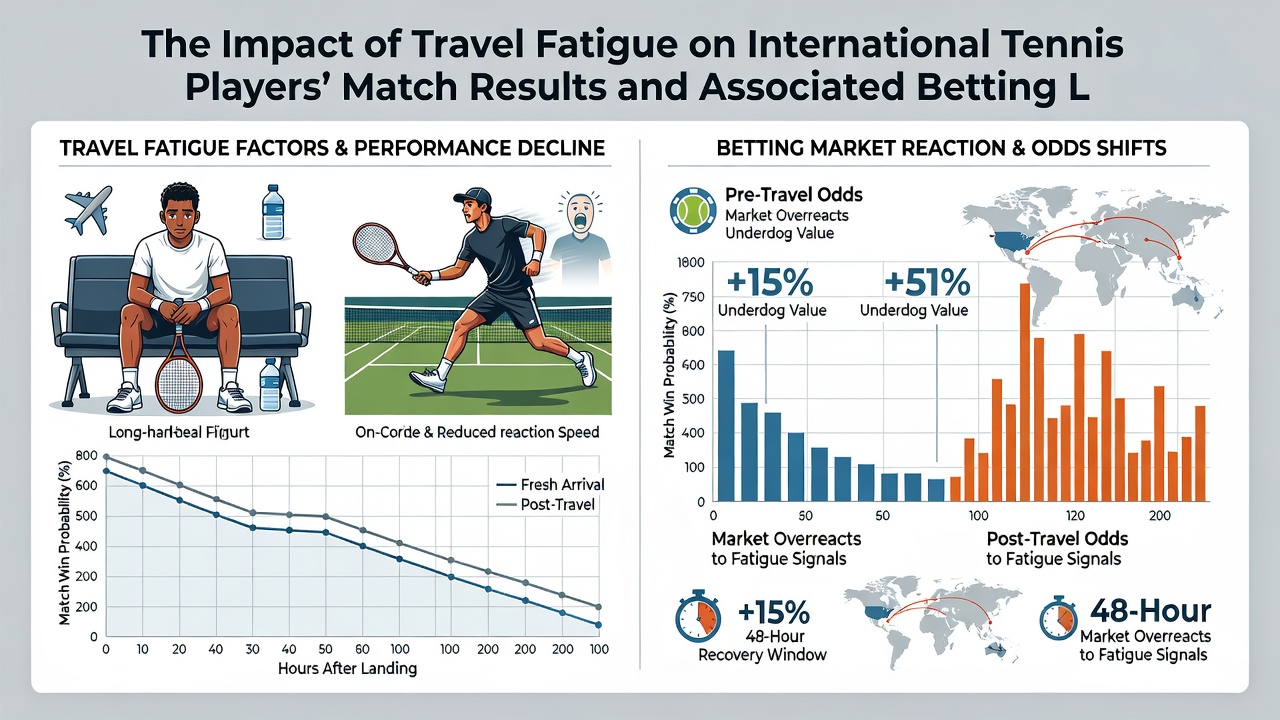
Market analysts also monitor cumulative travel loads across entire tournaments rather than single legs. A player who reaches semifinals after three consecutive intercontinental flights shows elevated underdog value in subsequent matches according to models published by independent quantitative research groups. These models incorporate variables such as total air miles logged in the preceding fourteen days, recovery days between events, and historical performance splits by time-zone differential. Resulting implied probabilities align closely with observed win rates once sample sizes exceed several hundred matches.
Case Examples from Recent Seasons
One South American player who flew from Buenos Aires to Tokyo and then onward to Indian Wells in early 2025 posted first-round win rates 12 percentage points below his established baseline, a drop that betting syndicates had anticipated through pre-tournament line shading. Similarly, an Australian competitor returning from European clay events to the Australian summer swing in 2024 encountered straight-set defeats in opening matches against lower-ranked opponents, outcomes that mirrored statistical expectations derived from travel-adjusted performance databases.
These examples illustrate how operators integrate publicly available flight schedules and ranking data to refine totals and spreads, while bettors who layer additional context such as practice reports and medical disclosures sometimes identify residual edges before lines fully stabilize.
Conclusion
Travel fatigue registers as a quantifiable factor in tennis results through documented changes in service efficiency, error frequency, and match duration. Betting lines reflect these patterns via systematic adjustments tied to flight distances and recovery windows, with models incorporating multi-year datasets producing probability estimates that track observed outcomes. Continued collection of physiological and performance metrics will likely refine these adjustments further as schedules evolve through 2026 and beyond.