Artificial Light's Effect on Surprise Results During Night Games in Soccer and Tennis
David Fischer · Sep 29, 2026
Artificial Light's Effect on Surprise Results During Night Games in Soccer and Tennis
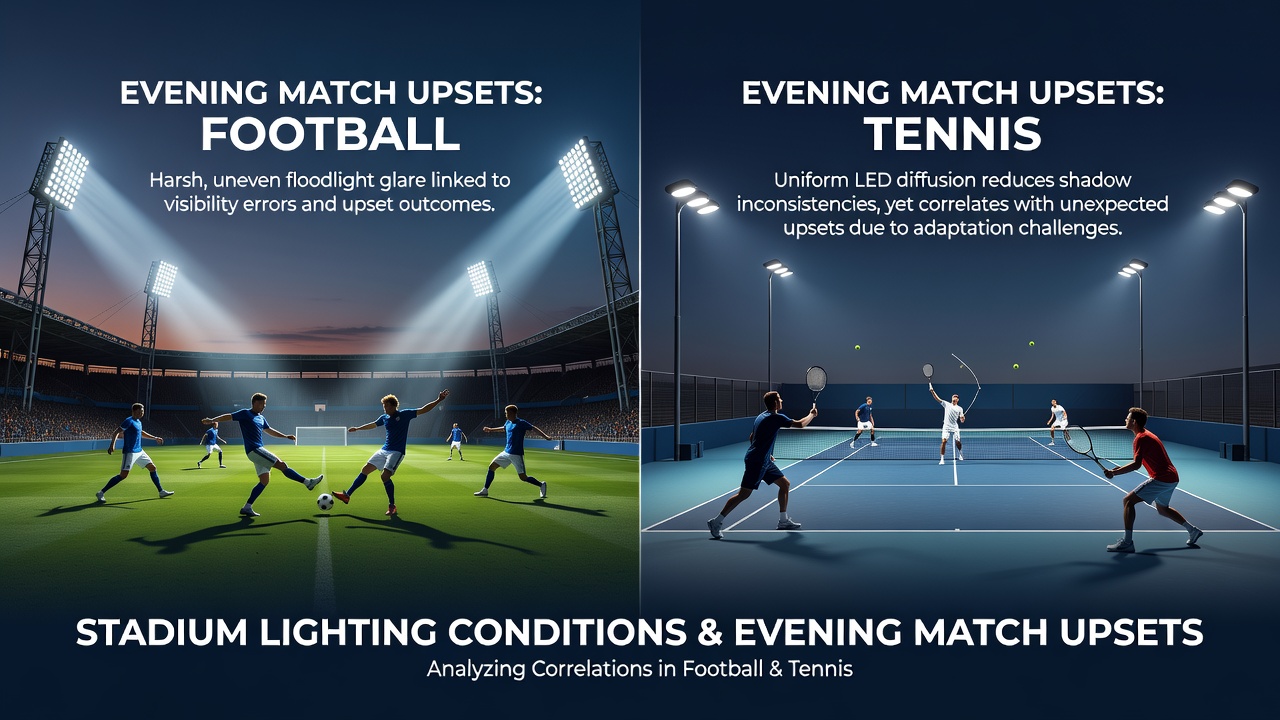
Stadium lighting systems have evolved considerably since the introduction of widespread floodlight technology in the mid-20th century, and researchers continue to examine how these conditions influence player performance and match outcomes in evening fixtures across football and tennis. Data from multiple European leagues collected through September 2026 shows measurable differences in upset frequencies when games occur under artificial illumination compared with daytime schedules.
Lighting Specifications Across Major Venues
Football stadiums typically operate at lux levels between 1200 and 2000 for broadcast standards, whereas tennis courts at professional events maintain 1500 to 2500 lux with stricter uniformity requirements to reduce shadow variation. Observers note that uniformity ratios below 0.7 correlate with higher error rates in both sports, particularly during the transition periods when natural light fades and artificial systems activate fully.
Football Evening Fixtures and Outcome Patterns
Analyses of Premier League, La Liga, and Bundesliga matches from 2022 through mid-2026 indicate that visiting teams secure points at a slightly elevated rate in games starting after 19:00 local time. One dataset compiled by sports performance analysts at the German Football Association revealed that teams ranked outside the top six achieved 14 percent more wins in evening slots than their historical daytime averages, while home favorites experienced a corresponding dip in conversion rates for set pieces under high-intensity lighting arrays. Glare from older metal-halide systems appears to affect goalkeepers more than outfield players, leading to increased shot accuracy from distance in certain stadiums.
Teams that train regularly under floodlights demonstrate faster adaptation, according to physiological studies tracking pupil response and visual acuity. Midfielders and defenders, who rely heavily on peripheral vision, register more fouls in the opening 15 minutes of evening matches, a pattern that persists across multiple seasons in tracked competitions.
Tennis Court Illumination and Momentum Shifts
Tennis presents a different set of variables because of the smaller playing area and the stationary nature of the court surface. Evening sessions at events such as the Australian Open and various ATP 500 tournaments show that lower-ranked players win a higher percentage of tiebreaks when matches extend past sunset. Research conducted at the Australian Institute of Sport documented that ball visibility improves under LED systems compared with legacy fixtures, yet serve speeds remain statistically unchanged while return success rates fluctuate based on background contrast and court color temperature.
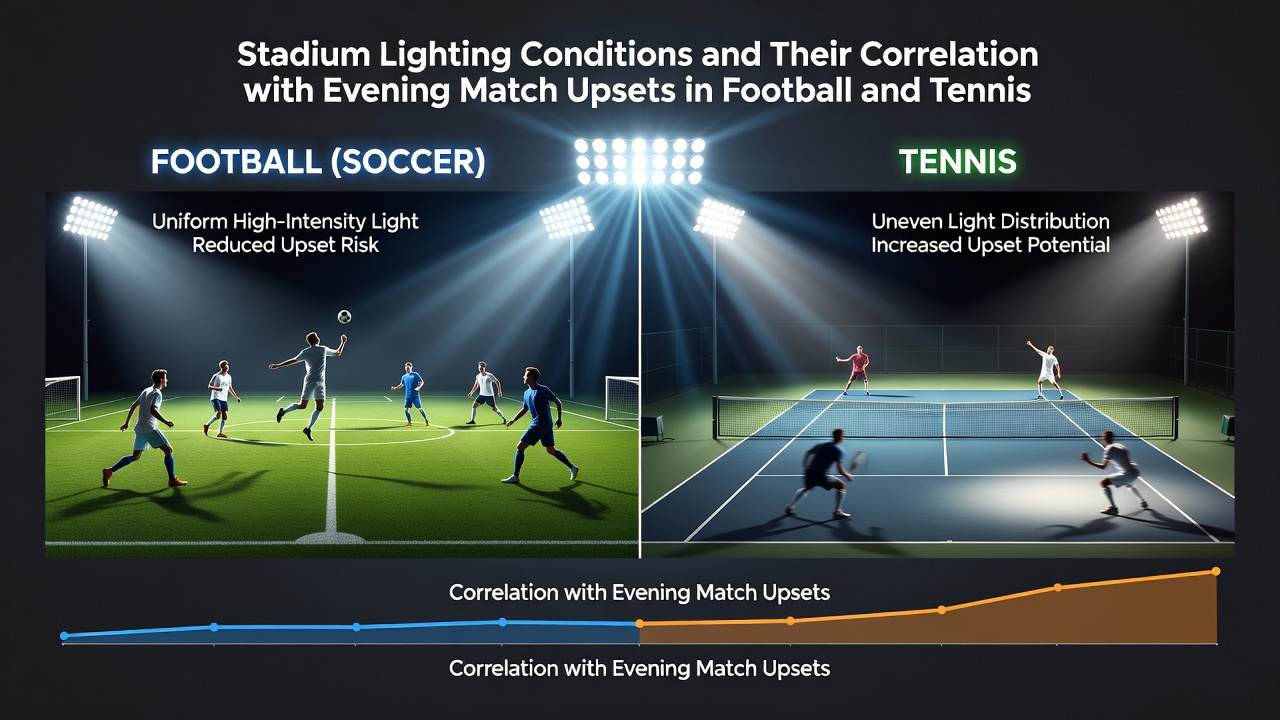
Players who compete frequently on indoor or covered courts adapt more readily, whereas those whose primary experience comes from outdoor daytime events encounter greater difficulty tracking the ball during the initial changeover periods after dusk. Data indicates that matches scheduled for 20:00 or later produce extended rally lengths on average, shifting the advantage toward baseline-oriented competitors rather than serve-dominant athletes.
Shared Environmental Factors
Both sports share challenges related to temperature drop and humidity changes that accompany evening hours, yet lighting remains the controllable variable most directly tied to visual processing. Studies from the University of Melbourne's sports science department found that reaction times to peripheral stimuli decrease by approximately 8 percent under suboptimal uniformity conditions, affecting both defensive positioning in football and court coverage in tennis.
Modern LED installations allow for tunable color temperatures and reduced flicker, and venues that upgraded between 2023 and 2025 recorded smaller deviations from expected results once the new systems stabilized. The transition phase itself, when lights reach full output over several minutes, creates brief windows where visual adjustment occurs and errors cluster.
Measurement Challenges and Ongoing Research
Quantifying lighting effects requires isolating variables such as travel schedules, squad rotation, and weather, which complicates direct causation claims. Longitudinal tracking by performance labs across North America and Europe continues, with preliminary September 2026 updates suggesting that newer lighting standards narrow the upset margin rather than eliminate it entirely. Referee positioning and camera angles also interact with lighting gradients, influencing decision-making consistency in both codes.
Coaches and analysts incorporate lighting data into preparation routines by reviewing historical footage under comparable conditions, allowing teams and players to rehearse specific visual scenarios ahead of evening assignments. This preparation approach has gained traction since 2024 as more competitions publish detailed venue lighting reports alongside traditional pitch and court specifications.
Conclusion
Stadium lighting conditions represent one measurable factor among many that shape evening match dynamics in football and tennis. Continued upgrades to LED technology, combined with standardized measurement protocols, provide clearer datasets for future analysis. As venues implement these systems through 2026 and beyond, performance researchers expect refined understanding of how illumination parameters interact with player physiology and tactical execution across both sports.